Dog Dance
World Championship
2016
Moscow
World Championship
2016
Moscow
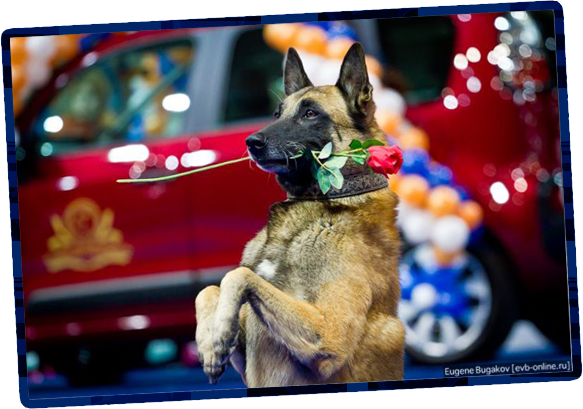
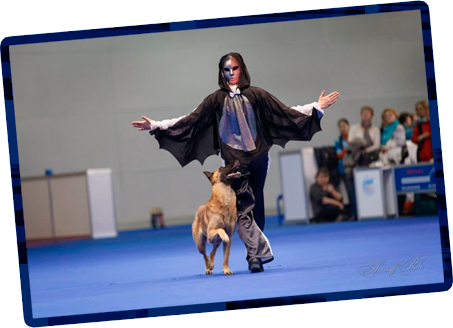
The FCI HTM & Freestyle World Championship is a 3 days event. The Freestyle team championship will be held on the first day, the HTM team championship will be held on the second day and the individual finals (for both sections 10 Heelwork to Music and 10 Freestyle) will be held on the third day.
Handlers can represent the country in which they reside or the country in which they have their citizenship.
Each participating country can enter a National Team consisting of three or four competitors to Heelwork to Music and three or four competitors to Freestyle.
Each participating team can have a named reserve (travelling or non-travelling) in each discipline. The reserve will only compete should one of the other participants on the team withdraw a dog from competition at the latest during the morning briefing on the day of the warm-up.
Should a country enter less than tree competitors in a discipline, they will still be able to compete for a place in the individual finals.
Individual entries can be submitted by the National FCI recognized Kennel Clubs.
Team entries can be submitted by the National FCI recognized Kennel Clubs.
If there are more than 4 entries + a reserve from one country, the FCI recognized Kennel Clubs' entries should be accepted before any others. If a Kennel Club does not wish to enter a team, the hosting country can decide which entries they wish to accept.
If a country’s Kennel Club or HTM/Freestyle Organization chooses not to enter a full team, entries for the rest of the available spaces up to 4 HTM dog and handler teams and 4 Freestyle dog and handler teams plus a reserve for each section from that country will be accepted from independent handlers.
These independent dog and handler teams will not compete as a team for the team title, but they can qualify for the individual final and compete for the individual title.
Winner of the FCI HTM & Freestyle World Championship in Heelwork To Music will be the country whose 3 highest scoring competitors have the combined highest scores from the qualifying round.
Winner of the FCI HTM & Freestyle World Championship in Freestyle will be the country whose 3 highest scoring competitors have the combined highest scores from the qualifying round.
Please note that only the 3 highest scoring dog and handler teams from each country's scores will count when the team winners are found.
Winner of the Individual FCI HTM & Freestyle World Championship in Heelwork to Music will be the competitor with the combined highest score from the qualifying round and the Individual Final.
Winner of the Individual FCI HTM & Freestyle World Championship in Freestyle will be the competitor with the combined highest score from the qualifying round and the Individual Final.
Draws should be made by the Host Country at the close of entries.
The draw should be videoed (and not edited) to show fairness.
Each Country to have two envelopes – one for HTM and one for Freestyle. Four papers are to be placed into each envelope. On each paper will be the name of a Team Member and their dog.
If there are less than 4 members in a Team, then blank papers will be placed in the envelope. Example: only 2 members in a team – in that envelope will be 2 named papers and two blank papers.
*
Draw the envelopes for the Running Order of each country for Heelwork To Music. For Example France 1, Germany 2, Japan 3 etc. If there are 12 countries entered there would be running orders in sections as follows: 1 – 12, 13 – 24, 25 – 36, 37 – 48.
From the first envelope, select one paper “Running Order 1”, the following paper would be “Running Order 13”, the third paper would be “Running Order 24” and the fourth paper would be “Running Order 37”.
Ensure there are always at least 10 dogs between handlers with multiple dogs.
Repeat from * for the Freestyle Running Orders.
Notify the Countries of their teams’ running orders.
All dogs are entered at the exhibitor’s own account and risk. The organizer cannot be held liable for damages caused by dogs or exhibitors.
Dogs must comply with the host country’s Dog Legislation.
Dogs competing must be at least 18 months old on the day of the competition.
No activity should be conducted which may injure the dog.
Once a dog has entered the ring to compete, no further practice is permitted.
The team is under judge’s orders from entering the ring to leaving it. All requests from the judges must be followed.
Each round in FCI HTM & Freestyle World Championship will be judged by five judges.
The highest and lowest score of each routine will be discarded. The judges’ points will be added, then divided by 3 – in other words the average points of the three judges will be the final score.
The judge’s decision cannot be appealed.
One judge is appointed “1st Judge”. This judge will have the final word when agreement cannot be reached.
In any case of doubt, the 1st judge will have the final word.
Heelwork to music:
If 2 dogs have equal points in the Heelwork to Music competition, the dog with the highest points in “Presentation and Accuracy” wins.
If they still have equal points the dog with the highest points in “Degree of Difficulty and Content” wins.
If they still have equal points, the 1st judge will decide the winner.
If two teams have equal points in the team competition, the winner will be found using the same criteria.
Freestyle:
If 2 dogs have equal points in the Freestyle competition, the dog with the highest points in “Music and Interpretation” wins.
If they still have equal points the dog with the highest points in “Presentation and Accuracy” wins.
If they still have equal points, the 1st judge will decide the winner.
If two teams have equal points in the team competition, the winner will be found using the same criteria.
Before the handler and dog begin their routine, the handler must acknowledge the judges at the table by bowing, curtseying or “nodding”. The dog can do a quick trick, but this should not take more than a few seconds to complete.
The dog is not allowed to be in costume or fancy dress. A decorated collar is permitted. If you are in doubt of what is allowed, ask at the briefing before the competition commences.
The dog must be off lead in the ring.
No food or toys are allowed in the ring.
Props can be used if they are appropriate to the choice of music and incorporated in the routine.
It is the handler’s responsibility to bring a helper that will place the prop in the ring p competition. Only the handler or his/her assistant can bring props into the ring before the performance.
Bitches in season are allowed to compete but must be kept away from the competition area until all the other routines are completed.
Bitches in season compete at the end of the competition.
The organisers must be notified that a bitch is in season as soon as possible and no later than at the morning briefing.
Music must be received by the organizers no later than 3 weeks before the event.
Music check-in times will be announced to the competitors no later than 3 weeks prior to the show.
The duration of the musical composition should not exceed 4 minutes.
A music file should be in MP3 format.
The file name must contain the following: discipline, country, name of the handler, nickname of the dogs.
It is the handler’s responsibility to hand in a USB-stick, which only contains the track/version of the music they wish to perform to.
It is the handler’s responsibility to bring a back-up USB-stick in case there is an error on the original USB-stick.
If a handler competes in HTM and Freestyle, the handler must hand in a USB-stick for each discipline (one USB-stick for each routine).
If a handler competes with several dogs, a USB-stick for each dog and class must be handed in.
If the music stops during a routine the competitor must be given the opportunity to complete the routine. The handler’s back up USB-stick may be used and/or alternative equipment, if this was the reason for failure. The judges will continue marking from the point at which the music stopped.
If the music stops during a routine, the handler can choose not to complete the routine and be judged solely on the part of the routine performed prior to the music stopping.
The dog is on lead in the ring.
The handler has food or a toy in the ring.
The handler practices harsh handling.
The dog relieves itself in the ring.
The dog is out of control in the ring.
The dog leaves the ring before the routine is completed.
If the dog attacks another dog or person in the venue or on the show ground.
If the dog barks continuously or for the greater part of the routine. If the barking disturbs the presentation or accuracy of the routine.
If the handler physically manipulates or holds the dog in a position/move.
Heelwork to Music is, as the name suggests, “Heelwork to Music“. The routine must therefore consist of at least 75% heelwork.
The dog must stay within 2 meters of the handler at all times.
The following positions are considered to be heelwork in HTM:
The dog has his left shoulder parallel with the handler’s right leg.
The dog has his right shoulder parallel with the handler's right leg facing opposite the handler.
The dog has his left shoulder parallel with the handler's left leg facing opposite the handler.
The dog between the handler’s legs with both shoulders parallel to the handler’s legs.
In front of, with his side to the handler. The dogs right shoulder must be in line with the handler's right leg or the dog's left shoulder must be in line with the handler's left leg.
Behind, with his side to the handler. The dogs right shoulder must be in line with the handler's left leg or the dog's left shoulder must be in line with the handler's right leg.
These positions must be kept the same in movement – the dog must not jump/bounce or ”crab” to keep the position by the handler.
The dogs body should be straight, and parallel to the handler.
The dog must not move in 2 tracks during heelwork, sideways movement is the exception to this rule. The dog must keep the same distance in relation to the handler in all positions.
The dog must move in the same direction as the handler. The dog must follow the handler’s choice of pace.
There is no requirement to heelwork or other specific moves in the freestyle competition, however it should be clear to the judges that it is a freestyle routine and the amount of heelwork should not exceed 25% of the routine.
Moves are defined as anything that is not heelwork. (for a definition of heelwork, see above).
|
GENERAL IMPRESSION – MAXIMUM SCORE: 10 points (to tenths) |
||
|
Cooperation and coordination between dog and handler |
The dog should be attentive throughout the routine and the dog and handler’s movements be in harmony. |
2 |
|
Implementation of the planned scheme dance |
The team must move confidently, with seeming ease. And they must clearly know all the movements of the dance. |
2 |
|
Gesture and voice commands |
The signals that the handler gives the dog must comply with the choreography and not detract from the performance. Voice commands should not be so loud that it interferes with the perception of the program. |
2 |
|
The expressiveness of the work of the dog |
The routine should be presented in such a way that attention is drawn to the dog or the teamwork of the dog and handler. The dog should be positioned during the dance, to ensure that the judges’ view is clear. The position of the dog during the dance in relation to the judges will also be evaluated. |
2 |
|
General impression |
The program must be designed for a wide audience and be interesting and original. The program should give the impression of being a cohesive whole, not a set of elements |
2 |
|
TOTAL |
10 |
|
|
THE LEVEL OF OF DIFFICULTY AND TECHNIQUE – 10 points (to tenths) |
||
|
Quantity of standard movements or heelwork positions (for HTM) |
Heelwork positions or basic moves in freestyle should be held long enough so that they can be assessed, but not so long as to suggest that the handler did not know any other moves to include in the choreography. Only standard heelwork positions/basic freestyle moves are evaluated in this category. Each position/move that is well performed earns 0.1 points. |
3 |
|
Quantity of original heelwork positions or elements of dance |
More difficult and original elements of dance or heelwork positions valued at 0.2 points for each original and difficult movements. The difficulty and originality of the elements is estimated based characteristics of the breed of dog. |
3 |
|
The choreography |
The dance should be presented in a fluid manner, without abrupt stops in the transitions between heelwork positions or dance elements; the transitions should be smooth, and the elements/transitions must fit nicely into the “fabric” of the routine. The choreography should highlight the dog’s natural movement in performing the dance. |
2 |
|
Use all available space of the ring |
The program should be structured in such a way as to effectively use the space of the ring, in line with the choreographic objectives, and taking into account the size of the dog. |
2 |
|
TOTAL |
|
|
|
INTERPRETATION OF THE MUSIC – – 10 points (to tenths) |
||
|
Interpretation of music |
Music should be interpreted. If musical composition tells a story, this story should be reflected in the dance. |
4 |
|
Expression of the music in the dance |
The dance should be in harmony with the music. All movements must be appropriate to the music and reflect its character. The dance should be performed so that the movement of the dog, the handler and the music are as one. |
4 |
|
The musical image and movement of the dog |
Movement (speed and style) of the dog must comply with the feel of the music. |
2 |
|
TOTAL |
|
|
|
PENALTIES (are deducted from the total amount) |
||
|
Improper use of costumes and / or props |
Props and costume should relate to the idea of the dance and the music, thus strengthening the impression of the dance. They should not only be used to control the dog during the performance. They should not be used merely in guiding the dog through the dance. If the handler uses a prop to encourage the dog, he gets "0" for the entire performance. |
3 |
|
Mechanical control of the dog |
Penalties will be applied for any mechanical control, including physically manipulating a dog into position or holding it in place (from 0.5 points). |
0.5-4 |
|
Barking |
Occasional barks which do not spoil the performance - 0.0 to 0.5 points Periodic barking throughout the performance - not more than 2 points Continuous barking throughout the performance - not more than 4 points. |
0.5-4 |
|
Dog’s condition |
Dog works without desire, it is under stress |
2-4 |
|
Violations of regulation |
For freestyle: use more than 25% heelworks positions in the dance. For HTM: use more than 25% elements of freestyle or if the dog moves away from the handler more than 2 meters |
5 |
|
Rough voice or gesture commands |
Voice commands are irritated or aggressive or rude gesture - no more than 3 points |
0.5-3 |
|
TOTAL |
|
|
|
Comments of the judge: |
||
|
TOTAL |
|
|